
Union County Historical Society Newsletter – January–February 2015, Number 122
A Year in Review
As we are about to start a new year, it seems to be a time to look back and see what the Society has done during the preceding one. At the start of the year our display case in the Hanson House featured the Singer Company, including a number of tools used by machinists to build and repair the machines used to make the company’s world-famous sewing machines. Winter ice and snow storms shut down some operations at the Hanson House, but staff members managed to keep things going, and by spring we were ready for our Annual Dinner.
The dinner program featured a review of Les Sargent’s work about the Medal of Honor recipients from Union County. His efforts resulted in a stone monument bearing their names being placed on the grounds of the Court House. Also about this time the Society announced that we now had a website, where activities of the Society will be readily available to anyone who may be interested. Society members also took part in the “Four Centuries in a Weekend” program. During the latter part of the year, the staff was very busy handling requests from companies for pictures they could use to adorn their office walls, with results that were quite satisfactory both to them and to us.
December Meeting
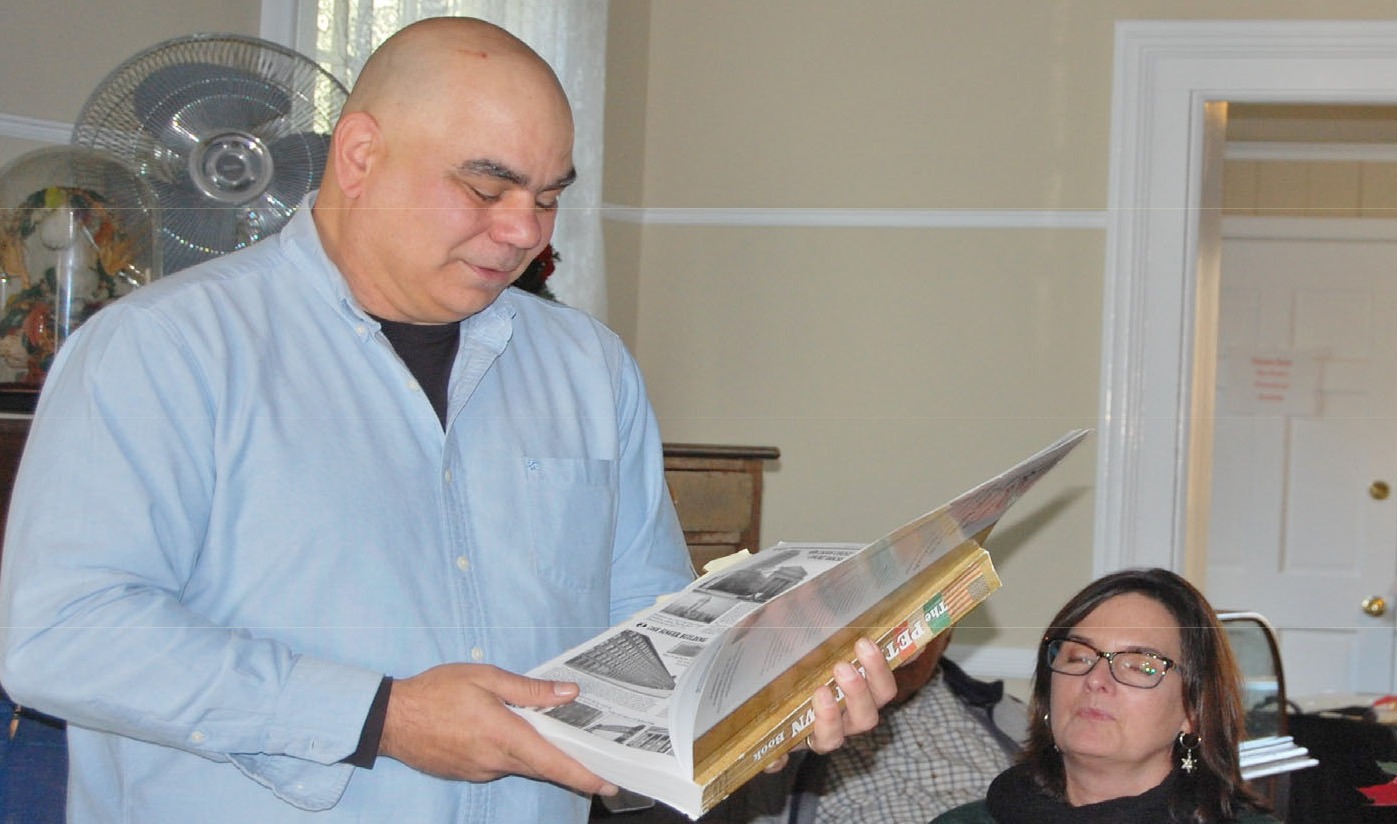
The December meeting was also our annual Holiday Party, where the membership enjoyed good food and good pleasantries with friends. The program was presented by Joe and Tina Renna, authors of a book about the Peterstown section of Elizabeth. This program had been originally scheduled for last February, but had been postponed because of heavy snows. We were fortunate that it could be rescheduled.
Christmas Long Ago
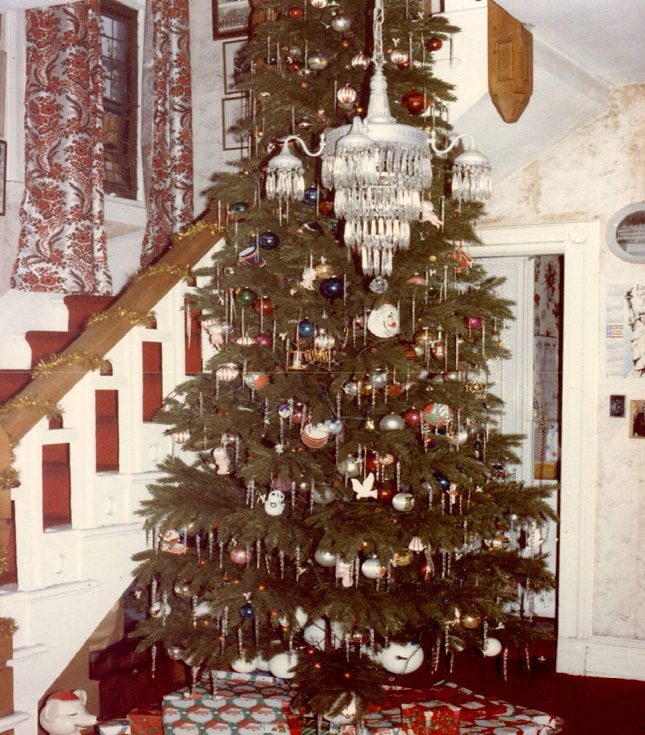
There was a time long ago when no one thought of Christmas until Halloween and Thanksgiving Day had passed, but today stores feature Christmas sales as early as the middle of October. Years ago, December could feel like a long stretch for children determined to stay on their best behavior until Christmas. The big stores downtown changed their front-window displays, featuring Santa’s helpful elves busy making toys, and electric trains running by themselves through miniature villages. Even Santa might appear in a store, raising the question of why he wasn’t at the North Pole preparing for the big day.
As the days went by, things at home began to change. The old evergreen tree in the yard lost a few small branches as decorations around the house. Their pleasant odor competed with cookies baking in the ovens, and the spices of plum puddings added to the mouth-watering atmosphere. The letter to Santa had been written, the familiar holiday stories re-read, and finally it was Christmas Eve. Christmas Eve was the longest night of the year to a small child, with sleep interrupted by unusual movements of grown-ups in the rest of the house.
Then it was morning. Somehow, a room downstairs had been changed as if by magic: a tall evergreen tree stood in a corner, with flashing lights and shiny colored ornaments. By the fireplace were gaily wrapped presents, and there was no doubt Santa had come down the chimney—on the hearthstone was a sooty footprint, and the cookies and milk left for him were gone. How it all happened in one night did not matter. Santa was indeed magical.
Pictures From Our Files
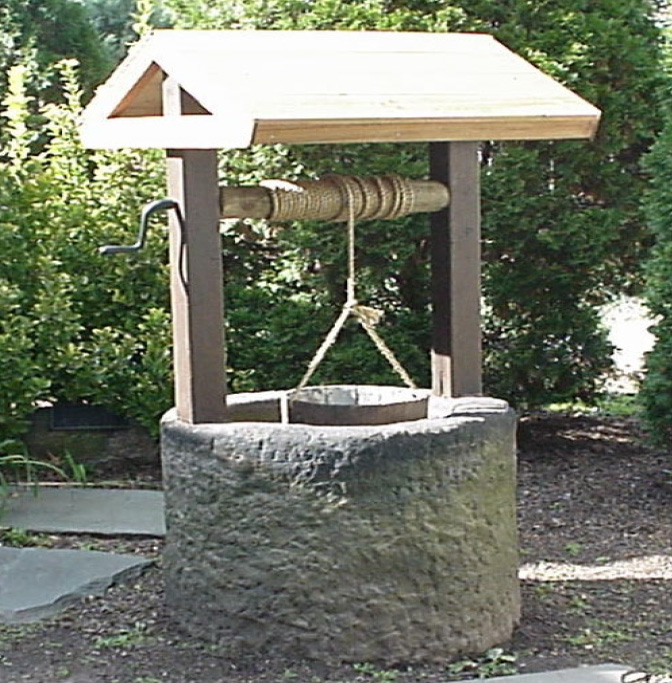
Pictured here is a well-house, typical of the many that once graced the yards of most houses years ago. In the days before city water was piped into homes, drinking water often came from wells such as this one. As an open well it was surrounded with a protective wall to prevent animals or people from falling in, and a roof overhead helped keep the water clean.
In use, a heavy iron-bound oaken bucket would be lowered into the well, tipped to fill with cool water, and then withdrawn by means of a windlass. Another method was a well-sweep: a long pole with a pivoted cross-arm, rope, and bucket, counterweighted so that a person could raise and lower a bucket with little effort. For a more continuous flow, a pump was needed—often a hand-operated pitcher pump with a cylinder, valves, and piston connected to a pipe set into the well. A less common device was a chain pump, using a loop of chain with cups attached; turning a hand crank brought cup after cup up from the well-water.
Another Year Gone Bye
It is that time of year when annual dues are due and payable in order to keep our Society up and running for the year of 2015. An addressed envelope and renewal slip are enclosed for your convenience.
Over the Back Fence
Barbara Sokol, computer specialist in our office, says there is never a problem with an obstinate computer—there is always a way.
Frequently Asked Questions
What were the Union County Historical Society’s highlights leading into 2015?
The Society featured new exhibits, hosted programs and events, supported local history initiatives, and expanded access through its website and community activities.
Who presented the Peterstown program at the holiday meeting?
Authors Joe and Tina Renna presented a program about the Peterstown section of Elizabeth.
How did households draw drinking water before indoor plumbing?
Many relied on wells using a windlass and bucket, well-sweeps, hand-operated pitcher pumps, or chain pumps.
Related Newsletters
Officer elections, Trinitas history program, Hanson House picnic with Model T cars, a circa 1840 Elizabeth drawing, and a tribute to Lester Sargent.
Civil War exhibit closes, picnic plans begin, Clark family genealogy questions, Revolutionary War history near Galloping Hill Road, and an Oliver & Drake donation.





 Our longtime friend and Society Treasurer, Bill Frolich, sadly passed away on September 30th 2021. He was 101 years old, a 45-year member of UCHS, and the writer/editor of our Newsletter. Bill and his extraordinary knowledge of Union County history will be greatly missed.