

Union County Historical Society Newsletter – September–October 2023, Number 172
ANNUAL PICNIC RAINED IN
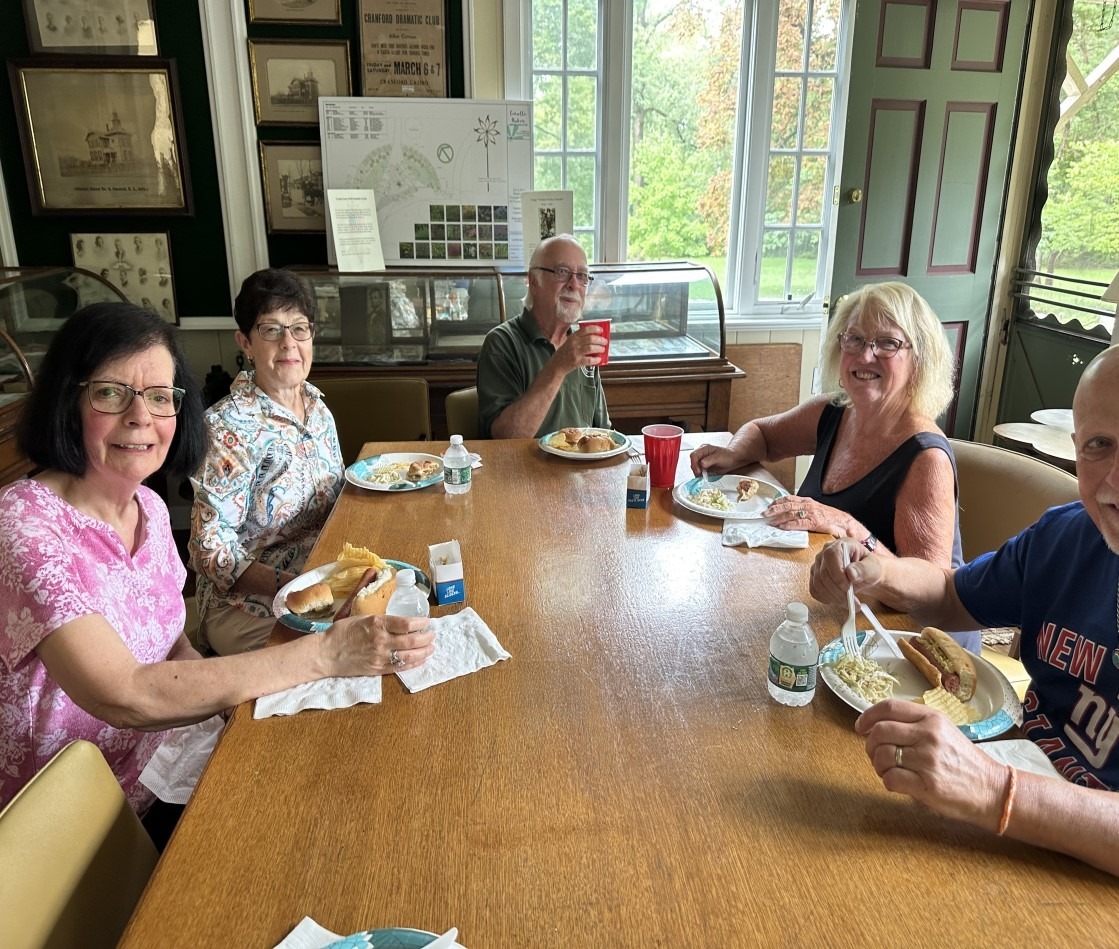
Despite threats of rain, the Society held its annual picnic indoors on September 10. This is the second year in a row that the weather forecast forced the annual picnic indoors. More than 25 members and friends attended. Participants enjoyed a great afternoon talking and eating hot dogs, White Castle hamburgers, homemade cole slaw, and pasta salad, along with many delicious desserts brought by guests. The membership engaged in lively conversations ranging from the destruction of old buildings in the county to graveyards, revolutionary spies, and a remembrance of the tragedy of 9/11. We’re hoping for sunnier skies next year!

DR. LUNDY TO SPEAK AT OCT. 1ST MEETING
Dr. Wanda M. Lundy, pastor of Siloam-Hope First Presbyterian Church in Elizabeth, will speak at the regular meeting of the Society on October 1st at 2 p.m. at the Hanson House. Her talk will center on the 313+ Ancestors Speak Project, an initiative researching the identity of free and enslaved African people buried in unmarked graves at Old First Presbyterian Church. The 313+ Project established a monument that honors the memory of their families and their contributions to the history of the Church, the City of Elizabeth, New Jersey, and the country.
Dr. Lundy is also the Executive Director of the Elizabethport Presbyterian Center and Assistant Professor of World Christianity at the New York Theological Seminary. A native of Alabama, Dr. Lundy received her BA Degree from Alabama A & M University; her MA from Howard University School of Divinity; her MDiv from the Interdenominational Theological Center; and a DM from New York Theological Seminary. In addition to the 313+ project, Dr. Lundy will bring us up to date on the status of the historic First Pres cemetery and church.
A VISIT FROM ABRAHAM CLARK AS IT OCCURRED ONE NIGHT TO WILLIAM FROLICH (Edited to fit in this newsletter’s space)
It was a cold rainy night, and inside the house, I started a warm cheerful blaze in the fireplace. I had been reading about some of the local history of Roselle, but soon got weary, and the book fell from my lap. As I sat dozing, the fire began to die.
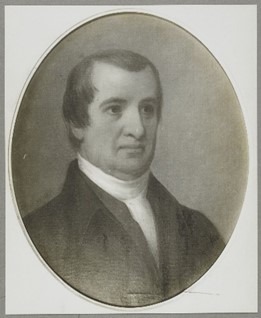
Suddenly, I was aroused as I seemed to hear a voice saying, “Excuse me Sir, but they tell me you know quite a bit of history of the town and what has happened through the last couple of hundred years”. I looked around and in the shadows, I could see a figure of a man dressed in quaint clothing and carrying a long-stemmed white clay pipe. I felt no fear, only curiosity of what I could do for him. I suggested that he make himself comfortable in the chair next to mine. He seemed agreeable, but as he passed between me and the dim light of the fireplace, the embers seemed to shine through him, but perhaps it was my eyes not just wide awake. As he sat and puffed his pipe, an ember flared up, and I recognized the face as that of Abraham Clark, dead since 1794. “I know you,” I cried, “your picture is hanging on the wall, you’re Abraham Clark!”.
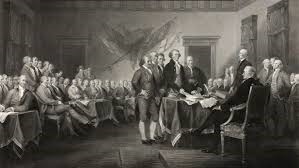
“Yes,” he replied, “and that picture painted by Trumbull was of the momentous occasion when we members of the Second Continental Congress accepted and were prepared to sign Thomas Jefferson’s Declaration of Independence“.
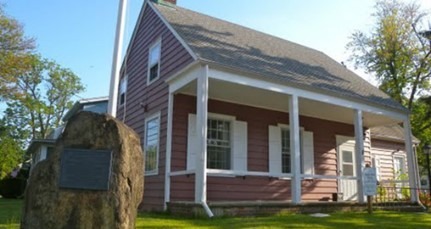
I thought for a moment. “There have been many changes here where you used to live. Your old farmhouse burned to the ground back in 1900, and the farm was developed with houses and a street intersection. There is a replica of your homestead that was built as a memorial to you by a group of men and women who can trace their ancestry back to someone who served our country during the American Revolution. They are known as the Sons of the American Revolution and the Daughters of the American Revolution. In 1919, a large granite rock was placed on Chestnut Street with a large bronze plaque that tells of your efforts to gain independence from England. Our high school is also named after you as is nearby Clark Township.
“There is another house in town that you should remember, and that is where your old friend Cavalier Jouet lived before he got in trouble with his neighbors because he was a Loyalist. The house is larger than it was when you were here, and it had to be moved slightly. When the founding fathers of Roselle laid out their village in 1865, that house was right in the middle of what they planned to be East Second Avenue. The house was on the old road that went from Williams’ Farms to Wheatsheaf Road, and it was no problem until about 1900 when a streetcar company began to lay tracks in East Second Avenue, and then the house was moved back out of the way and turned a little to face the avenue”.
“Oh yes,” he said. “I remember Cavalier. His family had to get out of France because of his religious beliefs and found refuge in England. He always felt that he owed England his loyalty. His wife was from a family of ardent patriots, which is probably why the villagers never burned down his house”.
I was silent for a few moments. Then I began again. “You might be interested to know that those old lamps and candles that you used to light up your rooms are now just used for decoration here. You probably remember Ben Franklin and his experiments with electricity. However, there was another man named Thomas Edison who did a lot more experimenting, and in 1879 he invented a glass bulb with a carbon filament inside and lit up a room when electricity was applied to it. He came around here in 1882 and strung wires on poles and connected the wires to three bulbs in anyone’s house that the owner would let him. He built an electricity generating station on West First and Locust Street, and whenever the generator was running, all the light bulbs were lit”.
My visitor seemed lost in thought and finally said, “In Congress, we thought long and hard before we decided to defy English law and declare ourselves independent of them”.
“You are right,” I said. “And if you and the others had not gone to the convention in Annapolis in 1786 to try to fix the Articles of Confederation we might not have the great country that we have today. Although that convention could not fix the Article, it did show that a constitution was needed to replace them”.
We both sat silent for awhile. The fire began to die out, and I realized that I was alone. My visitor had disappeared.
FREQUENTLY ASKED QUESTIONS
What was highlighted in the September–October 2023 issue of the UCHS Newsletter?
This issue features the indoor Annual Picnic, Dr. Wanda Lundy’s announcement about the 313+ Ancestors Speak Project, and William Frolich’s story “A Visit from Abraham Clark.”
Who is Dr. Wanda M. Lundy?
Dr. Wanda M. Lundy is the pastor of Siloam-Hope First Presbyterian Church in Elizabeth and Executive Director of the Elizabethport Presbyterian Center. She leads the 313+ Ancestors Speak Project honoring free and enslaved African people buried at Old First Presbyterian Church.
What is the 313+ Ancestors Speak Project?
An initiative that researches and memorializes African ancestors buried in unmarked graves at Old First Presbyterian Church in Elizabeth, culminating in a monument honoring their legacy.
Who was Abraham Clark?
Abraham Clark was a Union County resident and signer of the Declaration of Independence. William Frolich’s story imagines a nighttime conversation with Clark about America’s founding and progress.
Related Newsletters

Highlights from Union County’s March–April 2023 issue featuring Dr. Lurie, Dr. Rotunda, and the Marconi Wireless Building.
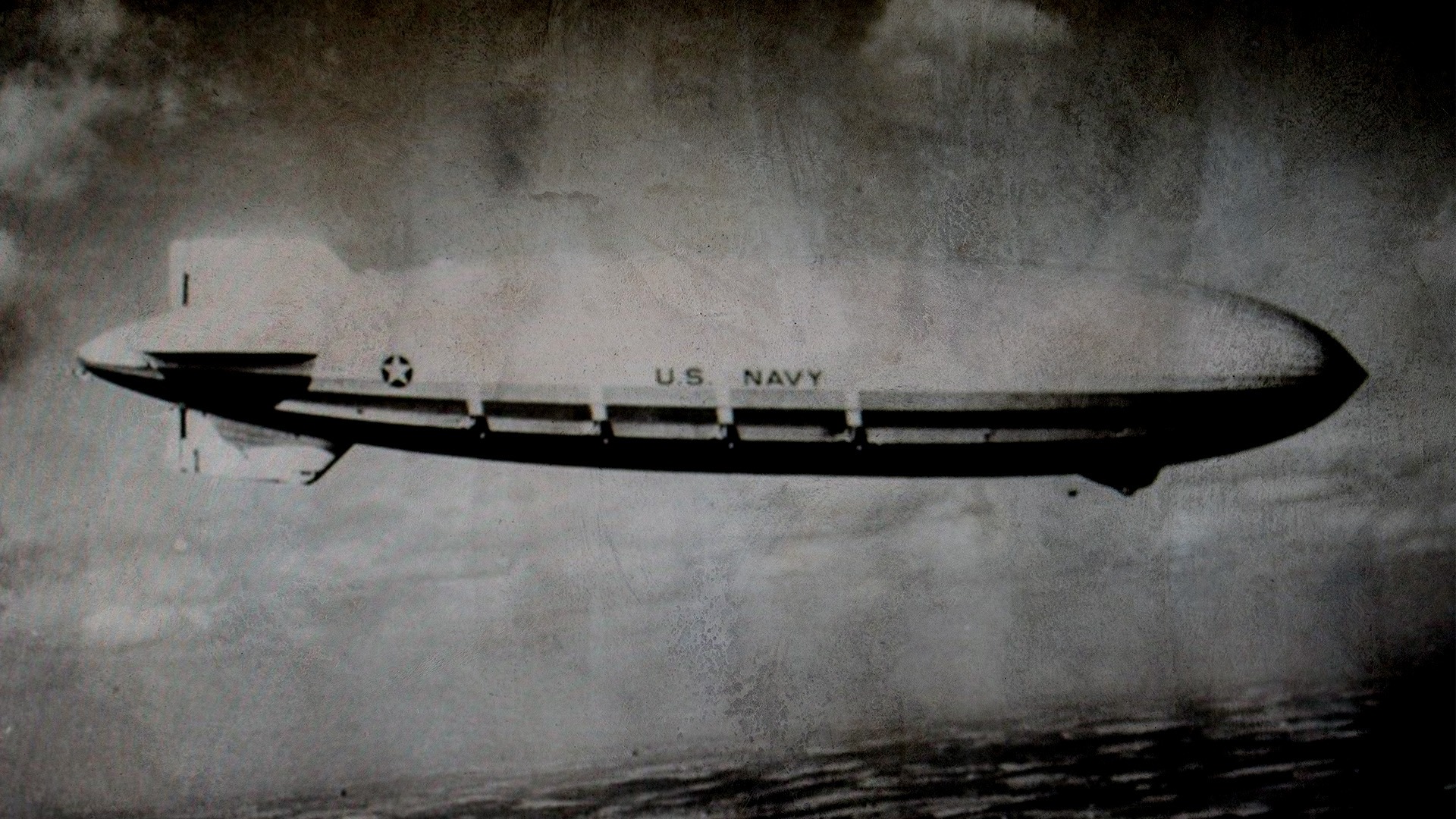
County seal history, Cover Girls holiday performance, and Bill Frolich’s memoir of the Morro Castle and Hindenburg tragedies.


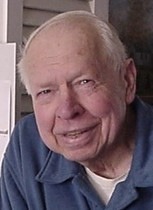 Our longtime friend and Society Treasurer, Bill Frolich, sadly passed away on September 30th 2021. He was 101 years old, a 45-year member of UCHS, and the writer/editor of our Newsletter. Bill and his extraordinary knowledge of Union County history will be greatly missed.