
Union County Historical Society Newsletter – September–October 2016, Number 132
Old Newspaper Treasures
Recently we were presented with some newspapers of many years ago, including a 175th anniversary edition of the Elizabeth Daily Journal. The paper was folded, and the outer layers were yellowed with age and very delicate. However, it contained a wealth of information on its pages, and the question was how to add that information into our computer. Scanning or photocopying might work, but would have involved too much folding of the fragile paper.
It was decided to spread each page flat on our desk and use a camera to photograph each desired item of interest. In a slightly darkened room the camera flash provided color-corrected, shadow-less light. Using a tripod, the camera was placed above the desk, each item was carefully positioned beneath it, and the exposure was made. After quite a number of shots were made, a cable was used to connect the camera to the computer and the shots were imported. The results were very satisfactory and the images can be cropped, copied, filed, or printed for future use. At another session a copy stand was made available and used in place of the tripod, making the work easier and allowing many more copies to be made.
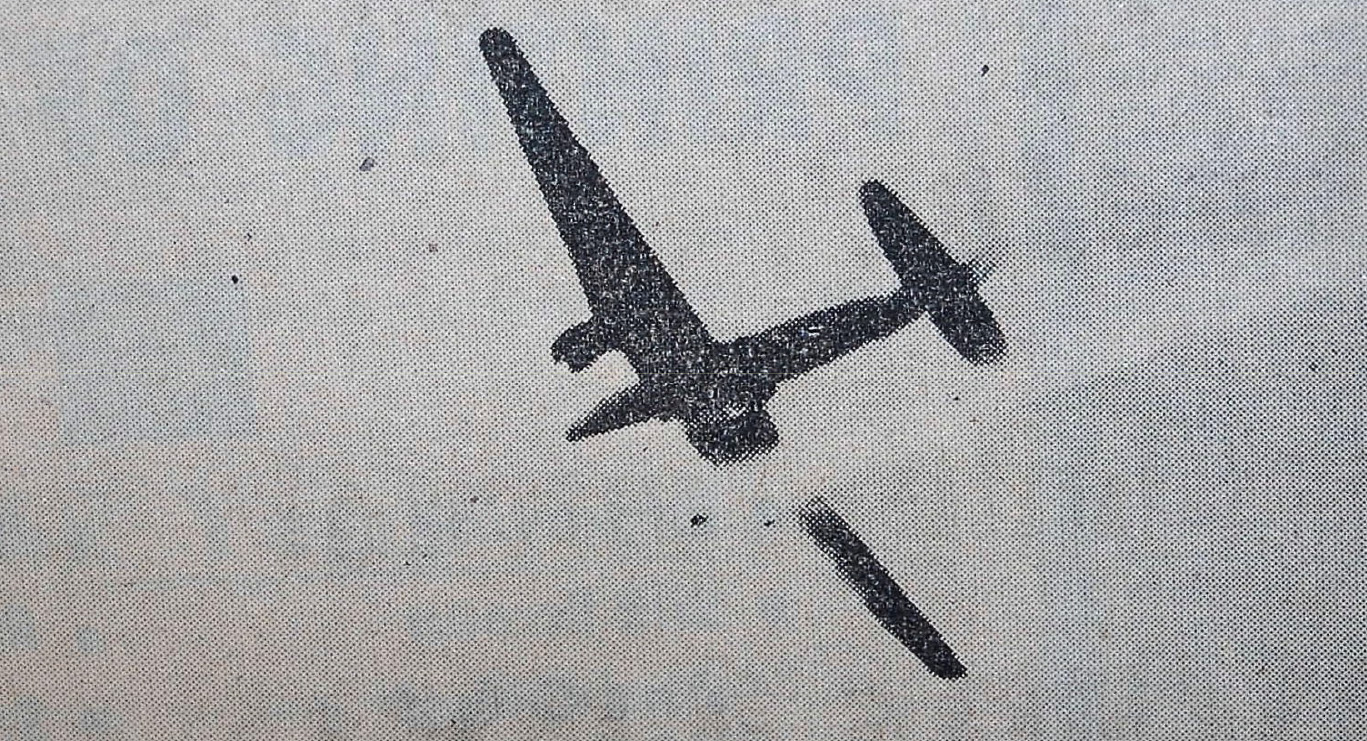
Although admitting that there had been other news through the years, the Journal proclaimed that the story of three airplane crashes in Elizabeth in 1951–1952 was the biggest news in the paper since the Revolution. In 1954 its special edition included a complete report with pictures about the tragedies that took 119 lives and closed Newark Airport for several months.
Among the items copied was an account of the wedding in 1778 of Elisha Boudinot to “Caty” Smith, the daughter of William Peartree Smith. The wedding took place in what is now known as the Belcher-Ogden Mansion, and among the guests were George Washington, Marquis de Lafayette, Alexander Hamilton, Gen. Thaddeus Kosciusko, Aaron Burr, Rev. and Mrs. James Caldwell, and Gov. William Livingston.
There was also the story of the traveling school bell that once hung in the schoolhouse at North Broad Street and Salem Avenue. When the school was torn down the bell was given to a fire company, and later to the Old Barracks in Trenton. It was returned to Elizabeth in 1916 and to the Women’s Club of Carteret Arms. When that building was razed in 1941, the bell went to Battin High School, and from there in 1950 to the new Third-Westminster Church, where it hangs today not far from its original site.
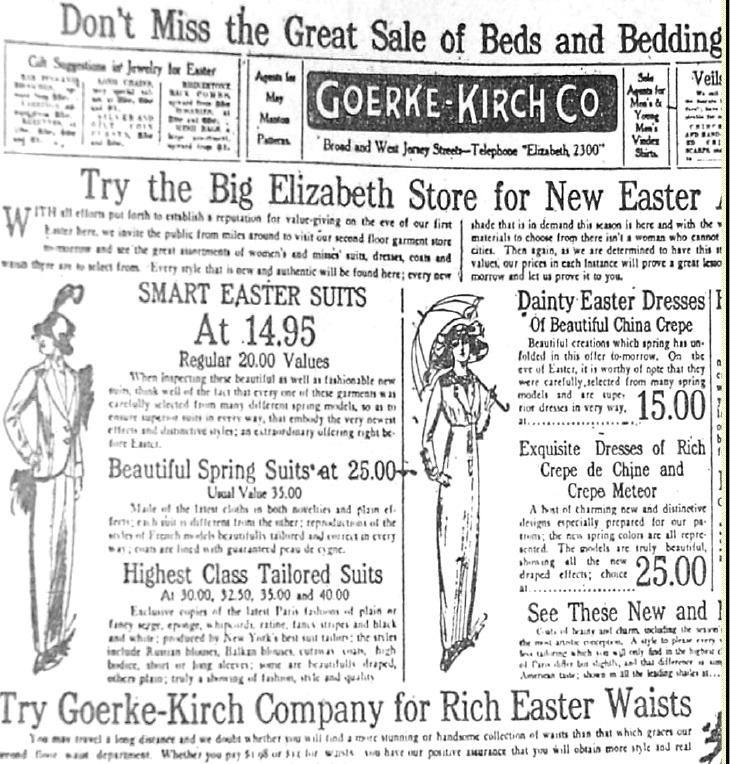
The advertising and prices were also very interesting. One example promoted the Goerke-Kirch Company and its seasonal sales, listing suits, dresses, and other items with prices that offer a vivid snapshot of consumer life in an earlier era.
Sub Built in City Was Pioneer
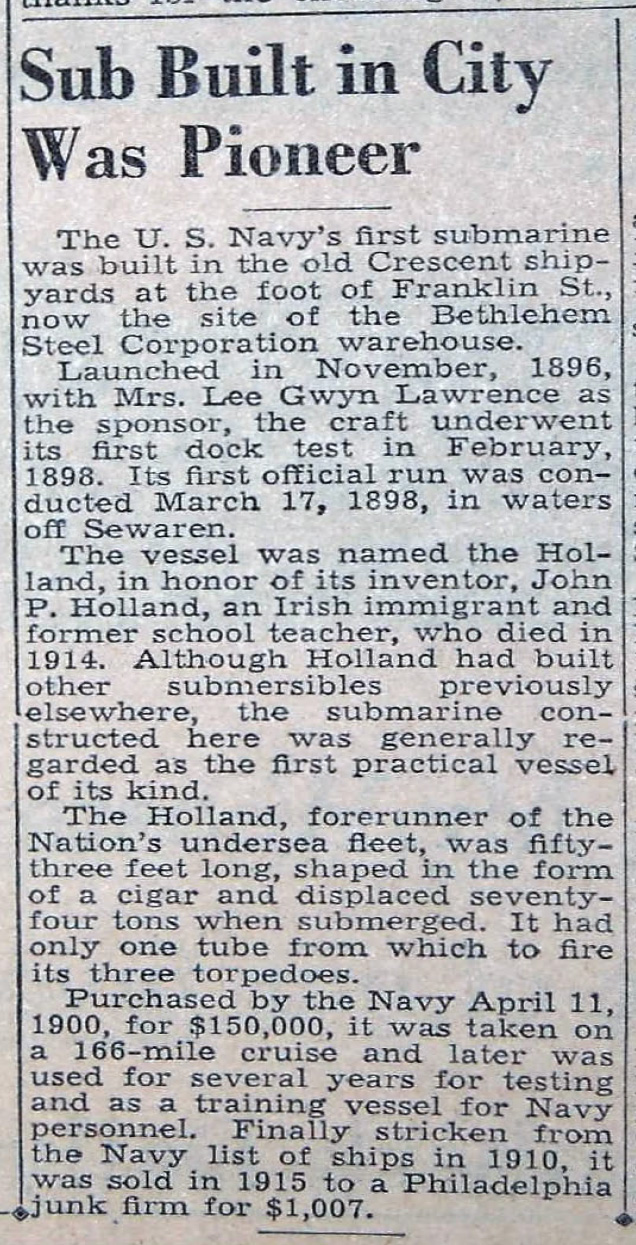
The U. S. Navy’s first submarine was built in the old Crescent shipyards at the foot of Franklin Street, now the site of the Bethlehem Steel Corporation warehouse. Launched in November 1896, with Mrs. Lee Gwyn Lawrence as the sponsor, the craft underwent its first dock test in February 1898. Its first official run was conducted March 17, 1898, in waters off Sewaren.
The vessel was named the Holland, in honor of its inventor, John P. Holland, an Irish immigrant and former school teacher who died in 1914. Although Holland had built other submersibles previously elsewhere, the submarine constructed here was generally regarded as the first practical vessel of its kind.
The Holland, forerunner of the Nation’s undersea fleet, was fifty-three feet long, shaped in the form of a cigar, and displaced seventy-four tons when submerged. It had only one tube from which to fire its three torpedoes.
Purchased by the Navy April 11, 1900, for $150,000, it was taken on a 166-mile cruise and later was used for several years for testing and as a training vessel for Navy personnel. Finally stricken from the Navy list of ships in 1910, it was sold in 1915 to a Philadelphia junk firm for $1,007.
Next Meeting Date
The next meeting of the Society will be September 11, 2016, at the Hanson House at 2:00 PM. This will be our annual picnic meeting, where any necessary business will be conducted as quickly as possible, including the presentation of a slate of officers for the annual election at the October 2, 2016 meeting, and then it is party time. The Society will provide the hot dogs, hamburgers, and soda, and members are asked to bring additional food of a picnic nature. The picnic will be held rain or shine, moving indoors if necessary, so come on out and enjoy a good time with friends and neighbors.
Annual Board Meeting
The annual meeting of the Executive Board was held on August 21 in the Hanson House where plans were made for the coming year of 2017. A slate of officers was prepared, showing very little change from the present members. Details of the picnic were finalized, with a hope for good weather.
Pictures From Our Files
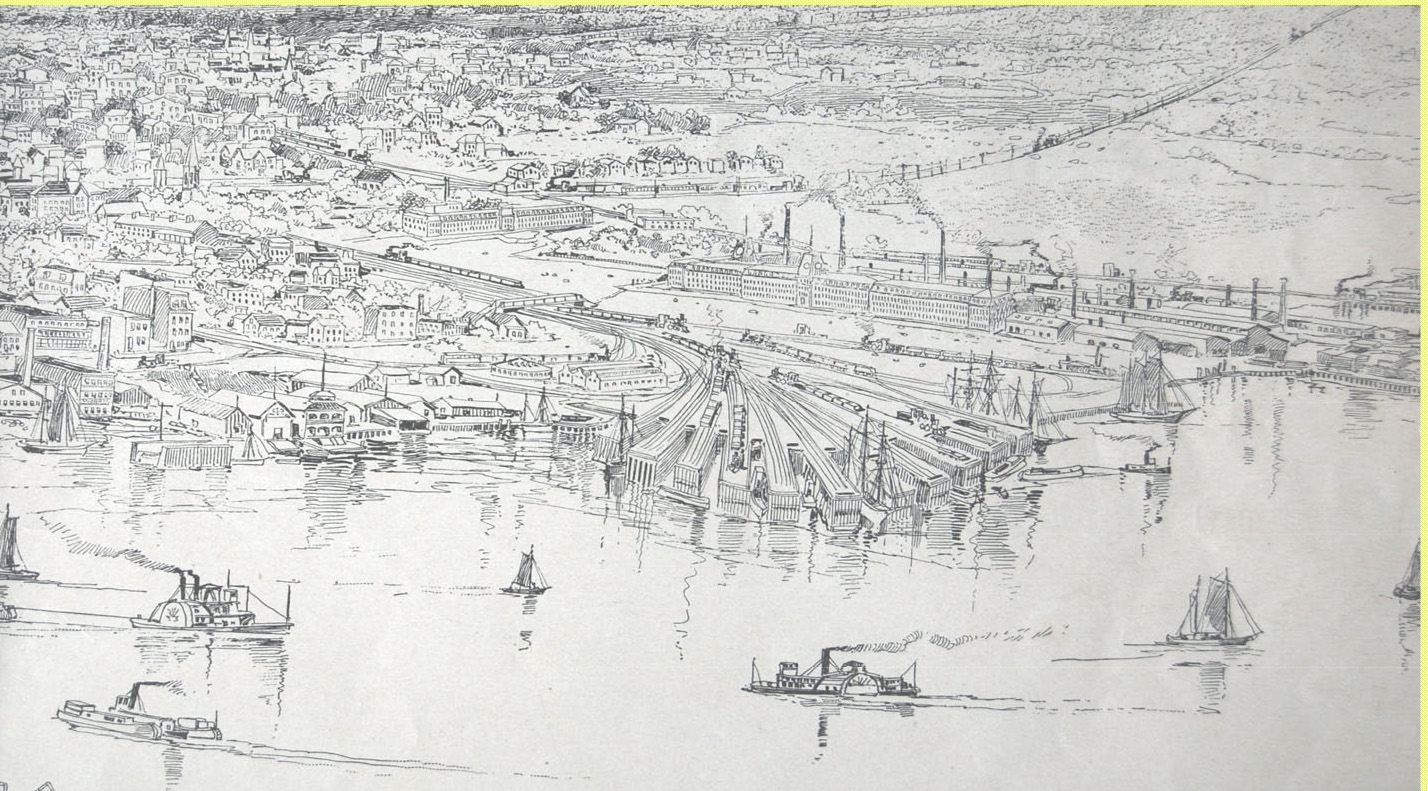
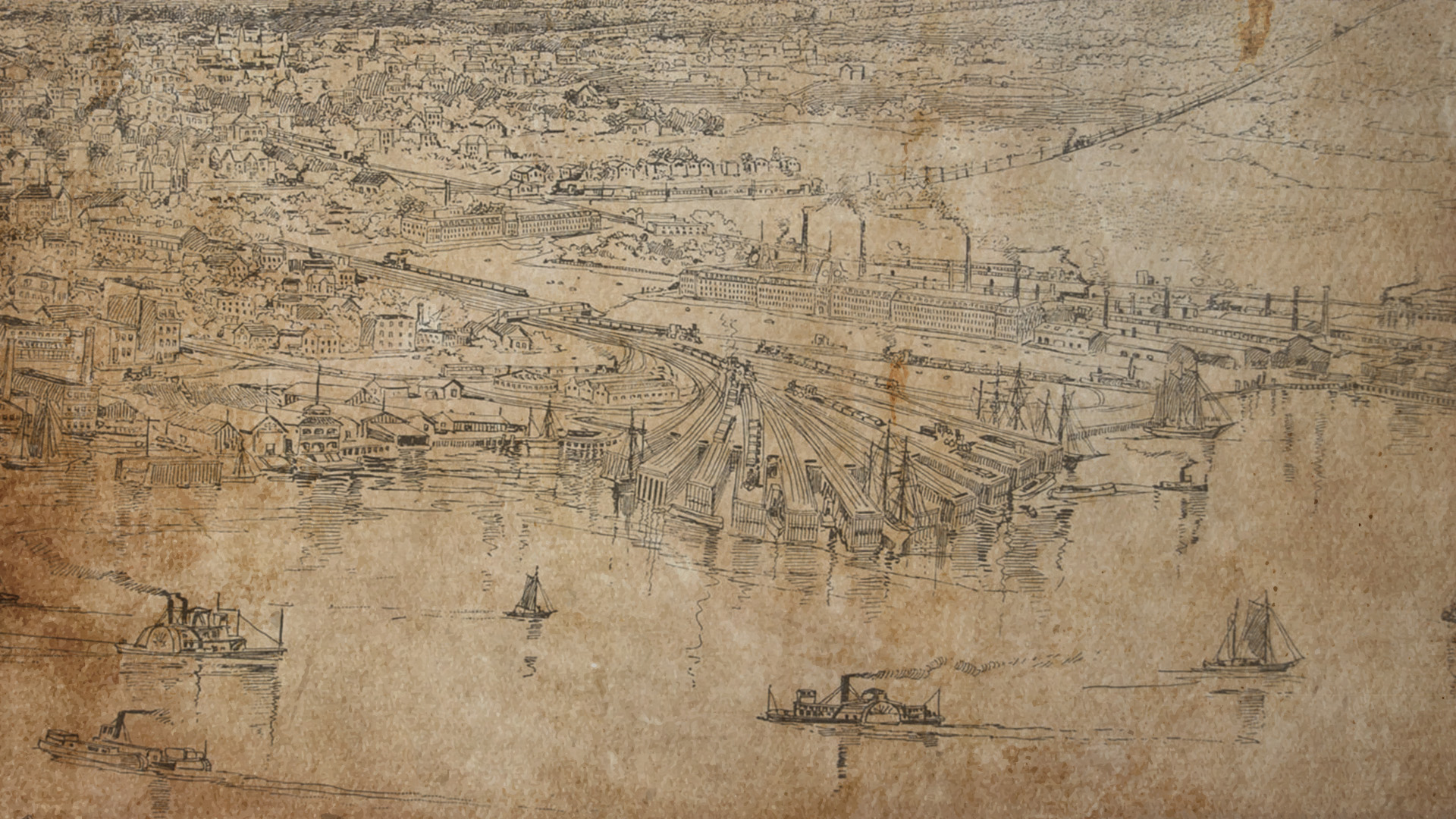
Here we have a “bird’s eye view” of the Elizabeth waterfront of about 1880 as drawn by an artist. The view is what a high-flying bird might see if it were over Staten Island and looking west. Drawings of this type were quite popular before the invention of half-tone screening allowed printers to reproduce actual photographs in newspapers and books.
It is unknown how this view was conceived by the artist, but it is possible that he had access to an actual aerial photograph taken from a balloon. Tethered balloons were used in the Civil War by armies to see what the other army was doing, and it would have been possible to take a camera aloft, even though photography was in its infancy.
Without an aerial picture to work from, an artist would have to visit the area from the ground that he wished to draw and then use imagination to show how that area might look from above. This drawing is amazingly detailed, with the coal docks of the Central Railroad in the center. Nearby to the north are the many buildings of the Singer Company, and even the Newark Branch of the railroad.
In the foreground are paddle-wheeled steamboats, probably ferries to and from Manhattan, along with sailboats and larger ships at the coal docks. Near the left of the picture, at the water’s edge, is the club-house of the Alcyon Boat Club at the end of East Jersey Street. It was from this club house in 1889 that President Benjamin Harrison departed, re-enacting the inaugural journey in 1789 of George Washington to New York City to be sworn in as the first President of the United States.
Over the Back Fence
Our president, Charles Shallcross, did a great job manning our exhibit July 8 at the Alexander Hamilton Fair at the First Presbyterian Church in Elizabeth. Our office work was interrupted recently when Barbara Sokol won the “Citizens’ Lottery.” She was awarded jury duty.
Frequently Asked Questions
What was the “Old Newspaper Treasures” project in Issue 132?
UCHS photographed fragile historic newspaper pages using a camera setup and copy stand to capture and archive clippings without damaging the paper.
Where was the U.S. Navy’s first submarine built?
The Navy’s first submarine, the Holland, was built in the old Crescent shipyards at the foot of Franklin Street in Elizabeth.
What does the 1880 bird’s-eye drawing of the Elizabeth waterfront show?
It depicts the Central Railroad coal docks, nearby Singer Company buildings, rail lines including the Newark Branch, and harbor activity with ferries and sailboats.
Related Newsletters
Issue 130 covers the anniversary dinner, a deep dive into Union County bandits, Washington-era leadership lessons, and Elizabeth’s 1938 “Own Your Home” house.
From Washington’s precedents to Ursino Lake’s lost “reservoir,” Issue 129 blends UCHS updates with Union County stories.


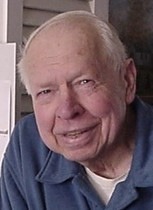 Our longtime friend and Society Treasurer, Bill Frolich, sadly passed away on September 30th 2021. He was 101 years old, a 45-year member of UCHS, and the writer/editor of our Newsletter. Bill and his extraordinary knowledge of Union County history will be greatly missed.